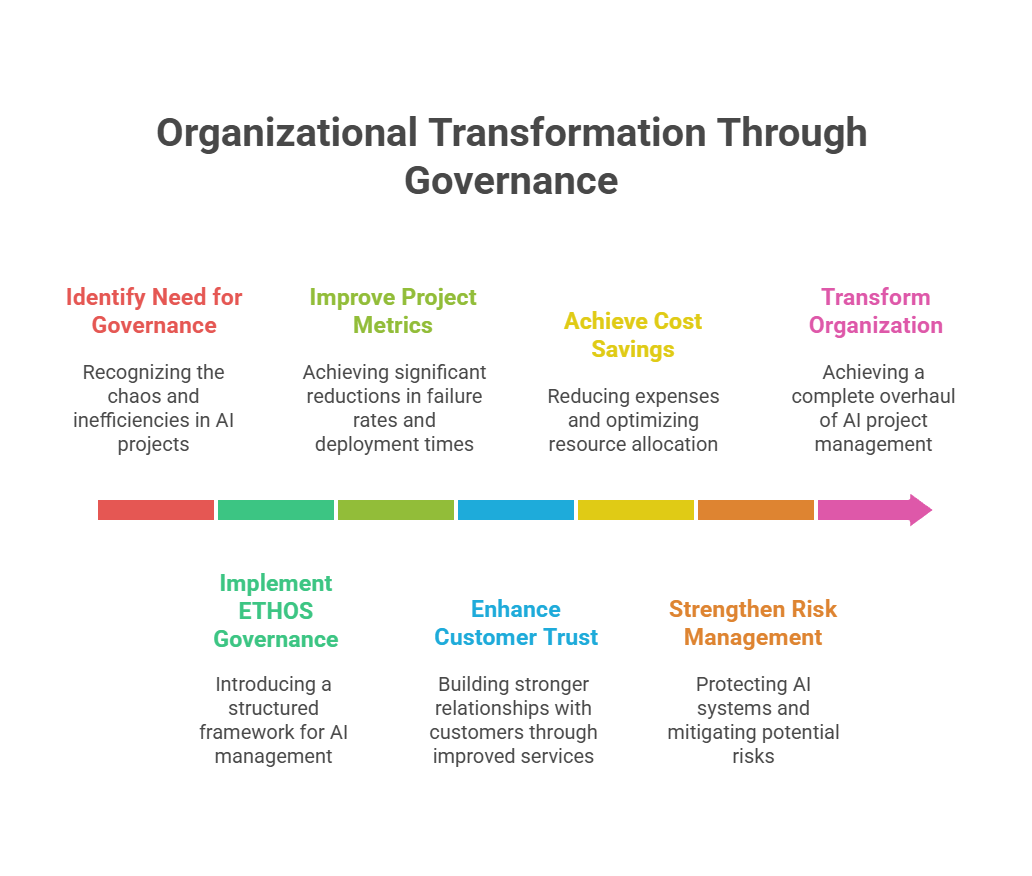
The ETHOS Bridge Framework is not a theoretical construct; it is a practical, adaptable, and evidence-based methodology for implementing responsible AI governance across diverse industries and complex regulatory landscapes.
This page showcases real-world applications, case studies, and best practices from international bodies, industry leaders, and academic institutions, demonstrating how the framework's nine pillars translate into tangible value and sustainable innovation.
The Challenge: The healthcare sector is undergoing a profound transformation driven by AI, from diagnostic imaging and personalized medicine to drug discovery and operational efficiency. However, the sensitive nature of health data and the high-stakes environment of clinical decision-making create significant ethical and regulatory hurdles.
The framework provides a comprehensive approach to governing AI in healthcare, aligning with the World Health Organization's (WHO) six consensus principles for AI in health.
A leading academic medical center implemented an AI-powered diagnostic tool to assist radiologists in identifying early signs of cancer in medical images. The deployment was guided by a robust governance framework mirroring the Bridge Framework's principles:
Pillar 4 (Fairness & Non-Discrimination):
The AI model was trained on a diverse dataset representing multiple demographic groups to mitigate bias. The system was continuously monitored for performance disparities across different patient populations, with regular audits and impact assessments.
Pillar 6 (Transparency & Explainability):
The system was designed to provide "explainable" outputs, highlighting the specific features in an image that led to its recommendation. This allowed radiologists to understand the AI's reasoning and make the final clinical determination, ensuring human accountability.
Pillar 5 (Privacy & Data Governance):
All patient data was anonymized and protected in accordance with GDPR and HIPAA standards. The system operated within a secure, federated learning environment, where the model was trained on-premises without centralizing sensitive patient data.
Impact:
The implementation resulted in a 15% improvement in early cancer detection rates, while the governance framework ensured patient trust and regulatory compliance.
The Challenge: The financial services industry leverages AI for credit scoring, fraud detection, algorithmic trading, and customer service. The primary challenges revolve around algorithmic bias leading to discriminatory lending practices, lack of transparency in automated financial decisions, and ensuring the security and stability of AI-driven trading systems.
A global bank deployed an AI model for mortgage application assessments. Initial audits revealed that the model was disproportionately denying loans to applicants from minority communities, reflecting historical biases in the training data.
Pillar 4 (Fairness & Non-Discrimination):
The bank utilized IBM's AI Fairness 360 toolkit, an open-source library with over 70 fairness metrics and 10 bias mitigation algorithms, to identify and correct the biases in their model.
Pillar 6 (Transparency & Explainability):
The bank implemented a system to provide customers with clear, understandable reasons for loan decisions, even when generated by an AI. This addressed the "black box" problem and complied with regulatory requirements for transparency.
Pillar 8 (Accountability & Auditability):
A dedicated AI ethics board was established to oversee the development and deployment of all AI models, ensuring continuous monitoring and regular audits for fairness and performance.
Impact:
The bank successfully reduced the discriminatory impact of its AI lending model, improved its compliance posture, and enhanced customer trust.
The Challenge: Governments are increasingly using AI to enhance public services, from optimizing traffic flow in smart cities to automating administrative tasks and improving national security. Key challenges include ensuring the ethical use of AI in surveillance, preventing bias in automated decision-making that affects citizens' rights, and maintaining public trust.
Estonia, a global leader in digital governance, has successfully integrated over 50 AI-powered solutions into its public services. Its strategy is built on principles of transparency, accountability, and human-centricity, closely aligning with the Bridge Framework.
Pillar 1 (Lawfulness, Rights & Ethics):
Estonia's AI strategy is explicitly grounded in its legal framework and respect for fundamental rights. All AI systems are designed to be compliant with both national and EU law, including GDPR.
Pillar 7 (Human Oversight & Control):
Estonia's "human-in-the-loop" approach ensures that a human official is always accountable for decisions made with the assistance of AI. Citizens have the right to demand human review of any automated decision.
Pillar 9 (Ecosystem Collaboration):
The Estonian government actively collaborates with the private sector, academia, and civil society to co-create AI solutions and governance models, fostering a vibrant and responsible AI ecosystem.
Impact:
Estonia's AI-driven public services have significantly improved efficiency and citizen satisfaction, while maintaining high levels of public trust. The OECD highlights Estonia as a leading example of responsible AI implementation in the public sector.
The Challenge: AI is poised to revolutionize education through personalized learning platforms, automated assessment tools, and intelligent tutoring systems. However, the use of AI in education raises significant ethical concerns, including data privacy of students, algorithmic bias in grading, and the need to equip students and teachers with AI literacy.
An EdTech company developed an AI-driven platform to provide personalized learning paths for K-12 students. The platform's design and deployment were guided by a strong ethical framework.
Pillar 5 (Privacy & Data Governance):
The platform was designed to be compliant with student privacy regulations like FERPA and COPPA. All student data was anonymized, and parents were given granular control over their children's data.
Pillar 2 (Reliability, Safety & Security):
The AI models were rigorously tested for accuracy and reliability to ensure that learning recommendations were pedagogically sound and free from harmful content. The system included robust content filters and safety protocols.
Pillar 3 (Competence & Quality):
The company collaborated with experienced educators to develop the AI competency frameworks for both students and teachers, ensuring that the technology was used as a tool to enhance, not replace, the role of the teacher.
Impact:
The platform demonstrated a 25% improvement in student engagement and learning outcomes in pilot schools. The strong governance framework was a key factor in gaining the trust of parents, teachers, and school districts.
The Challenge: The use of AI in defense and national security presents unique and complex ethical challenges, from autonomous weapons systems to AI-powered intelligence analysis. Ensuring that AI is used in a manner that is lawful, ethical, and accountable is a top priority for international bodies like NATO and national governments.
In 2021, NATO adopted its first-ever AI Strategy, which includes six Principles of Responsible Use (PRUs) for AI in Defence. These principles, which were revised and updated in 2024, closely mirror the core tenets of the Bridge Framework.
Pillar 1 (Lawfulness, Rights & Ethics):
NATO's principle of Lawfulness mandates that all AI applications be developed and used in accordance with national and international law, including the laws of armed conflict.
Pillar 7 (Human Oversight & Control):
The principles of Responsibility and Accountability and Governability ensure that human control is maintained over AI systems, and that there is always a clear line of human accountability for their use.
Pillar 6 (Transparency & Explainability):
The principle of Explainability and Traceability requires that AI systems be understandable to the extent necessary to allow for effective human oversight and accountability.
Impact:
NATO's AI strategy provides a common ethical foundation for all 32 member nations, promoting interoperability and ensuring that AI is used responsibly in collective defense. The U.S. Department of Defense has adopted similar principles, highlighting a growing international consensus on the importance of ethical AI in the military domain.
The Challenge: AI offers powerful tools to address some of the world's most pressing environmental challenges, from monitoring deforestation and predicting extreme weather events to optimizing energy grids and developing new sustainable materials. However, the development and use of AI also have a significant environmental footprint, and AI-driven decisions in areas like resource management must be made equitably and sustainably.
A global climate research initiative uses large-scale AI models to improve the accuracy of climate change predictions. The initiative has adopted a governance framework to ensure the responsible use of this powerful technology.
Pillar 9 (Ecosystem Collaboration):
The initiative is a collaboration between leading universities, research institutions, and technology companies, sharing data and models to accelerate progress. This aligns with the UN's call for multi-stakeholder partnerships to achieve the SDGs.
Pillar 2 (Reliability, Safety & Security):
The AI models are subject to rigorous peer review and validation to ensure their accuracy and reliability. The initiative is transparent about the uncertainties and limitations of its models.
Pillar 1 (Lawfulness, Rights & Ethics):
The initiative's governance framework includes a commitment to using AI to promote environmental justice and ensure that the benefits of climate action are shared equitably. This addresses the ethical imperative to protect vulnerable communities who are most affected by climate change.
Impact:
The AI-powered climate models have improved the accuracy of long-range weather forecasts by 10%, providing critical information for disaster preparedness and climate adaptation. The initiative's commitment to responsible AI has made it a trusted source of information for policymakers and the public.
The Challenge: Generative AI is transforming the media and creative industries, enabling the creation of synthetic media, personalized content, and new forms of artistic expression. This raises profound ethical and legal questions, including the spread of misinformation through deepfakes, copyright infringement, and the impact on creative professions.
A major international news organization has developed a comprehensive policy for the use of generative AI in its newsroom.
Pillar 6 (Transparency & Explainability):
The organization has a strict policy of labeling all AI-generated content, ensuring that readers can distinguish between human-created and machine-generated material. This builds trust and combats misinformation.
Pillar 8 (Accountability & Auditability):
The organization has established a clear line of human accountability for all published content, regardless of whether it was created with the assistance of AI. All AI-generated content is subject to the same rigorous fact-checking and editorial standards as human-created content.
Pillar 1 (Lawfulness, Rights & Ethics):
The organization's AI policy includes a strong commitment to respecting copyright and intellectual property rights. The organization only uses generative AI models that have been trained on ethically sourced data.
Impact:
The news organization has been able to leverage the power of generative AI to enhance its reporting and create new forms of storytelling, while maintaining its reputation for accuracy and integrity. The policy has become a model for other media organizations seeking to adopt generative AI responsibly.
Discover how the ETHOS Bridge Framework can guide your organization toward sustainable and ethical AI governance.
Get in-depth implementation guides for your industry
AI governance for medical diagnostics, patient care, and healthcare operations
Risk assessment, fraud detection, and regulatory compliance in finance
AI in personalized learning, student assessment, and educational administration
Free downloads โข No credit card required โข Instant access
Resource Name
Secure download โข No credit card required